
1. What is on page SEO
2. How to rank on page SEO
3. What are the factors that matter in on page SEO?
4. How to optimize your content for on page SEO?
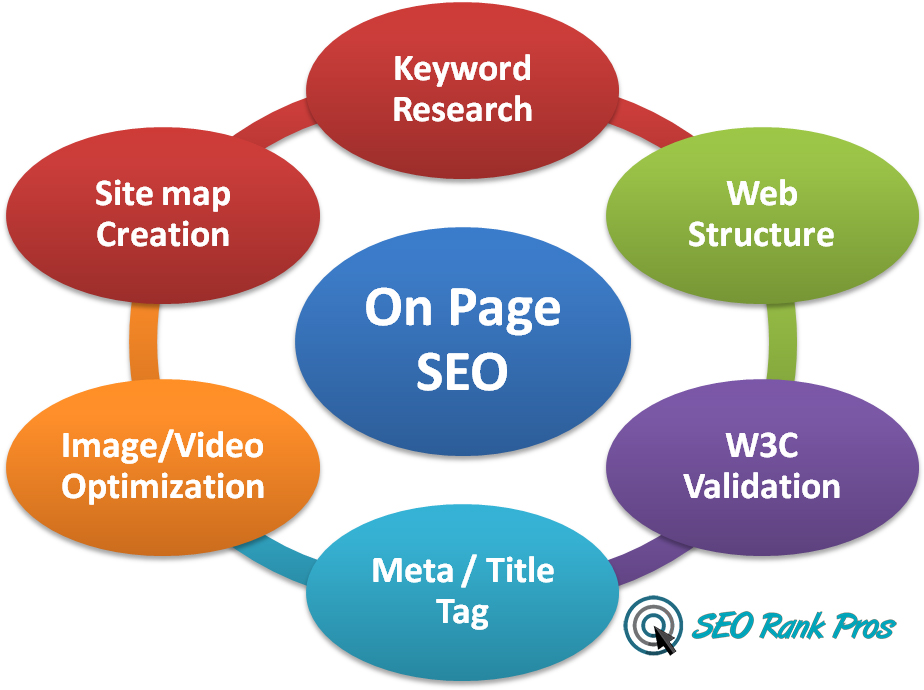
On-page SEO is an important aspect of each website that wishes to rank on Google. What is On Page SEO? As the name suggests, it means adding values to your web pages which will help them in ranking higher and getting better visibility when people search with keywords related to your product or service. What you put in articles, how they are organized matters a lot.
What is on page SEO
On Page SEO can be divided into 2 main categories:
– What do you do before publishing the content (on page SEO)
– What do you do after publishing the content (off-page SEO)
These two categories cover almost everything that is needed for your webpage(s) to get an improved ranking in SERP’s. It needs you to know what are backlinks, how they affect your website’s ranking, what is page authority, and why it matters.
What are forums & social media, where you might get the best out of them (no spamming though…). What are keywords exactly? What is meta tags? What is keyword density? How many times should my target keywords be used in the article per 100 words? What kind of text formatting I should use while writing an article for better on-page SEO results? All these need to be answered properly for higher rankings to happen naturally.
What if you don’t have any idea about On page SEO?
Don’t worry! This guide will help you with some basic tips that may not turn your website into a top-ranking overnight but surely will give you an idea of what is On page SEO & How to use it for your website?.
First, let’s check out What are backlinks? What causes backlinks and why do so many of them matter while doing On-page SEO? What role do they play in ranking websites on Google?
What are backlinks you ask? Backlinks are links on other websites which link out to your website. The more high quality backlinks you have pointing to your site, the higher your sites search engine ranking will usually be for certain keywords. It’s widely believed that the most important part of an SEO campaign is creating good quality backlinks to your website.
Now before we get into how many links you should ideally have pointing at your site (and what types of links) lets take a look at some different types of external links;
1. Do-follow links
These kinds of links allow external webmasters complete control over their linking options and can help encourage them to leave their link on your page.
2. No-follow links
These kinds of links do not pass any ‘link juice’ (or whatever you want to call it) and are commonly added by webmasters who don’t want people to follow them or gain any SEO benefits from linking to you.
However, if the external webmaster has linked out to your site with a no-follow tag then Google will not count this link towards your SEO rankings (although there is debate surrounding whether they do or don’t).
Also, many website owners like adding no-follow tags to all their outgoing website links for branding purposes so other websites won’t start following their links in order to gain some quick unnatural backlinks.
What should I do about no-follow links? You could argue that it doesn’t matter if your site is gaining these kinds of links because they won’t help with SEO (and, to an extent, you’re right). What really matters here though is the fact that Google indexes no-follow links and counts them towards your backlink profile.
This means that even if a website owner has linked out to your site using a no-follow tag there’s always a chance (however small) that their link will still count for something in regards to SEO. Why would someone add a no-follow tag to their link? Some webmasters do this (and some SEO experts suggest that they should only be ‘tolerated’ on certain websites) in order to provide ease of mind for users. This means that if you don’t want people clicking your external website links, then adding a no-follow attribute will ensure this doesn’t happen.
3. Pingback / Trackback
This kind of linking option allows the author of another website the ability to notify you when they’ve written an article about something related to one of your blog posts.
What should I do about pings and trackbacks?
The chances are that if the blog is anything to go by, then any website getting regular pingbacks or trackbacks will probably have a good reputation for quality content. This means that one of the first things you need to check when looking at a new backlink profile is whether there are any external sites which send you regular trackbacks/pingbacks. What you should always monitor is the number of referring domains pointing to your site and their ‘weight’ (to use a weighing analogy) and it’s also advisable to check the authority of the referring websites. You need to be able to tell the difference between a high quality link and one which won’t do anything for your SEO.
4. Contextual backlinks
These kinds of links are where other website owners publish articles about your company or blog on their own website, talking about how great some aspect of your business or blog is (usually related either to what they’re selling or who they want their customers/visitors to become more interested in).
What should I do about contextual backlinks? What many people don’t know is the fact that Google often doesn’t index these links, so they won’t help with your search engine rankings at all. If you have a lot of good quality contextual links then, provided that Google are indexing them, they will improve your site’s natural rankings. Of course, regular link building efforts are always recommended in order to continue getting regular high quality contextual links pointing to any website which also helps with keeping your site well indexed by Google.
5. Automated
What you can do is automatically link keywords on your website to various external sites.
What should I do about automatically generated backlinks? What many people either forget or don’t know is the fact that Google doesn’t index a lot of these websites and so they won’t be of much help when it comes to improving your search engine rankings. What does this mean? What it means is that automated links are generally known as being ‘bad’ for SEO purposes, especially if they’re from low quality websites which aren’t likely to be of any use.
What should I look out for in regards to my backlinks? What you should always be aware of is which links are no-follow and which links have a ‘dofollow’ parameter added. What does this mean? What does this mean? What does this mean? What it means is that websites with a lot of dofollow links will probably send more visitors than those which don’t, so if you’re making use of some kind of link exchange program then these kinds of links are definitely the ones that you want to target first.
Editorial – What I would recommend doing first is creating an interesting article or blog post on website about something relevant, helpful, entertaining or just plain interesting to your readers. What should I do about editorial links? What many people don’t realise is the fact that Google doesn’t officially allow you to trade links with other websites, so doing this could result in them not indexing your site very quickly What does this mean? What it means is that even if you get a link on another website which has a lot of authority, if they’ve obtained it by trading links then Google will probably see this as being somewhat unnatural and it could actually do you more harm than good.
What is Page authority & how it comes into the picture while searching for keywords related to your business/website?
Page authority is a tool provided by Moz which is used to measure the quality of any particular webpage & how it ranks among the top search results in Google. You can read more about it here (opens in new window). What we will do here is discuss how page authority plays an important role while optimizing your website/business for certain keywords so as to be viewed prominently on search engines.
When you type a keyword related to your business or perhaps even information related to your specific topic, you want that page/website come up at the top of the SERPs (search engine result pages) because it contains relevant and useful information for users who are looking for such keywords. So how does this happen? What do SEOs or search engine optimizers do to make their page appear on the top of the SERP?
There are two main factors in which SEOs play a role. One is on-page optimization & another is off-page optimization. On-page basically means all those activities which you can perform in your control, like keywords in H1/H2 heading tags, writing unique and relevant content, meta descriptions for your webpages – all of this improves your page quality scores by Moz’s algorithm. We’ll get into more details about on-page later but before that we need to understand how Moz generates its authority score of a webpage by looking at different elements such as:
- Moz Page Authority (PA)
- Number of linking root domains
- Number of total links to a page
What is PA? In simple words, Moz Page Authority (PA) score represents the quality & quantity on how well a particular webpage/website ranks among all other results. As you can see from above, an authority score ranges from 1-100 where anything 40 and above is considered to be authoritative while anything below 30 is not so good for your website rankings. What factors do these two elements affect by page authority? What does this mean for my website’s SEO efforts? Let us understand it with the help of an example of a niche topic: “Best laptop under $500”.
Google Keyword Planner provides approximate monthly search volume data for keywords, which helps you determine how much competition there is for specific keyword & what sort of traffic any particular website/website page would get if the keyword were to be used.
Keywords: Best laptop under $500 What’s our goal here? We want our webpage (our website) to come at the top of search engine results when anyone uses this keyword. So let us assume that Moz authority score for Amazon & Newegg are 90 & 70 respectively while their link count is 1000s and 100s respectively. What does this mean?
In simple words, Amazon has a better power when it comes to ranking on Google SERPs compared to Newegg since Amazon’s PA is higher than that of Newegg with more number of linking root domains & pages indexed. What does this tell us? People are more likely to click on Amazon’s listing for “Best laptop under $500” over Newegg due to the former having an authority score of 90 compared to 70 for Newegg. What is best practice use case scenario of high page authority scores?
1) If you are an eCommerce website selling any product related to our example topic, make sure your webpage comes up on top of search engine results with a significant margin because Google takes into account how authoritative your website is while ranking your webpages. This will help increase your sales since more people would be visiting your website and clicking on products. So it would be beneficial to optimize every single webpage that you have in terms of Page Authority. What do I mean by that?
Write a unique & useful piece of content related to your product Make sure your page’s PA score is 40 or above Bounce rate must be low Especially for a new webpage, the bounce rate should not be much since it takes time for search engines to index webpages and show them in SERPs. What you can do is make sure that your website has an active blog where you post fresh content every week which will serve as a good source of link building opportunities What are backlinks? What does Moz say about quality backlinks?
Backlinks are the number of websites linking to any particular webpage/website. Google uses this factor along with other factors such as anchor text and Page Authority score while ranking pages on SERPs. What is anchor text? What does Moz say about quality backlinks? Anchor Text is the visible & clickable part of any link that people see on SERPs/websites linking to your webpage. What are the best practices for acquiring good quality backlinks?
-URL needs to be clear & simple
-Press releases are one of the best ways to generate links with ease What are press releases & how they work? Press Releases are official announcements made by businesses or individuals which aim at informing general public about new products, advancements in technology, newly launched websites, newly acquired companies etc. What you need for this is a PR distribution platform where you can pay and publish your press release so that it reaches thousands of news portals What you need to do? What are the best practices for acquiring good quality backlinks? What is page authority What does Moz say about quality backlinks What are press releases
2) Businesses offering SEO services should note that higher Page Authority of a webpage will help them rank better with high search volume keywords. This is why it becomes important to optimize all pages of your website from an SEO perspective along with creating new webpages as an ongoing process as opposed to focusing only on certain webpages.
What does keyword density really mean?

One of the most common symbols used to point out a keyword is the percentage symbol, appearing as “%”. For example: “website optimization” could have a density of 30%. This means that thirty percent of all words in this article are either “website”, “optimization”, or both.
This practice has been a staple part of search engine optimization for nearly half a decade now. It was first devised by experts who wanted to find ways to boost their websites up through the search results without actually paying to be ranked higher via pay-per-click campaigns.
In fact, it has been found that if you focus your text enough on one specific topic, you may even rank number one organically within Google’s listings… using nothing more than great content and proper keyword density.
But how do you calculate keyword density? It’s actually very simple, but there are several schools of thought when it comes to percentage calculations.
Here is one formula:
(# of _____ in the _______) / (total # of words – excluded stopwords) * 100 = % Keyword Density for Exact Match Searches
Keyword _____ in the _______ Examples: “website” in the article “how to build a website” “optimization” in the article “search engine optimization expert advice” total # of words – excluded stopwords The number that remains after you have removed all punctuation, numbers, special characters, spacing anywhere within the article, and all stopwords (in most cases, the words “a”, “an”, and “the”).
The number of words without any of these things removed is typically between 500-700. 100 Calculate this percentage by taking the (# of _____ in the _______) divided by (total # of words – excluded stopwords).
Example: for our example above (“website” in the article “how to build a website”), we would take (3/300) to get .1 or 10%
for our other example (“optimization” in the article “search engine optimization expert advice”), we would take (9/660) to get .13 or 13%. If you were using this calculation to gauge your article’s keyword density, you might choose to give an article a percentage above 13%, depending on the subject matter and search engine optimization strategy.
The second way of calculating keyword density is:
(# of _____ in document) / (# of total words) * 100 = % Keyword Density for General Match Searches.
What are some basic factors that you need to keep in mind when writing content, which will help you rank higher by naturally getting more backlinks (SEO).

If you are reading this article, then it’s likely that you already know the basics of writing good content to get higher rankings in Google. The purpose of this article isn’t to tell you the basics of what you should be doing when creating SEO content. It is to help you avoid some common pitfalls when trying to rank for specific keywords using long-tail [specific] anchor [link] text [anchor text].
The most important factor in writing or optimizing a website for search engines is naturally attracting inbound links from other websites so that your domain and page gets indexed and ranked in organic search results. People tend to think that search engine optimization means getting more traffic, but this couldn’t be further from the truth. SEO is all about making your website visible when people search for relevant keywords.
The best way to optimize your website is by providing unique, relevant and high quality content on a regular basis to attract inbound links. Let’s take a look at some common mistakes that don’t allow you to rank well with proper anchor text.
1) Not having good anchor text : You might be surprised, but it isn’t always easy to get people who link out to your site using the exact keyword that you are trying to rank for. If you want people to link back with specific keyword(s), then use variations of the word repeatedly throughout your content so they can easily find something worth linking back with.
2) Using keyword stuffing : I’m not telling you to go out and write the same keyword over and over again all over your website (that is called keyword stuffing), but if you already have some text on your page that is relevant to the topic at hand, then there’s no harm in repeating it once or twice within 300 words.
3) Using incorrect grammar : We’re not perfect, but when people read articles with poor grammar, spelling mistakes and punctuation they are less likely to trust what you are saying. Make sure that you edit everything before publishing your content online; search engines pick up on this stuff too!
4) Not using long-tail keywords : The more specific your keyword phrase is, the better. It takes a lot of time to find good long-tail keywords – they aren’t as easy to find as they used to be; we now have Google Instant and auto-complete features which make it harder for search engines and humans.
5) Not submitting your site to the search engines: Make sure that you submit your website or blog to major search engines like Google, Yahoo and Bing etc. Most people will tell you what you should expect from this process, but most people will probably forget to tell you that there is a very high probability of not doing well in SERPs (search engine results pages) because many of these submissions are done automatically by bots. So unless one of the bots happens to crawl your website when someone does a relevant query, then your site is unlikely to show up in SERP’s.
6) Not submitting your site to the social sites: You should also submit your website or blog to major social media websites like Facebook, Twitter, LinkedIn, StumbleUpon etc. Make sure that you send them a link to either an RSS feed of your posts or one home page of your site which has the most relevant content on it. If you are using WordPress then use their “press this” feature so that you have a direct link with good anchor text when people share your posts on these social networks.
7) Not having enough quality backlinks : One of the biggest factors in getting indexed and ranked in major search engines is naturally attracting links from other sites because they consider link popularity as votes for your site. The stronger the backlink, the higher your website will be ranked. You can find a list of high PR (page rank) websites to get links from by using Google advanced search and entering “link:yourdomain.com” in the search box (replace “yourdomain.com” with your actual domain name).
8) Not getting enough traffic : While getting more relevant traffic is good for search engine rankings; you need to make sure that you focus on providing great content rather than trying to increase traffic. As mentioned earlier, focus on creating unique and interesting content because there is no point ranking well without anyone visiting your site – remember, it’s all about quality not quantity!
9) Over-optimizing : Search engines look for websites that are not over-optimized; that means they do not like to rank sites where the creator of the content is trying to manipulate search engine rankings. If you hire an agency (or a freelancer) to write your website copy, make sure that they don’t use any black hat SEO techniques or tactics which might get your site banned by Google and other search engines.
10) Not having enough backlinks : We mentioned this in another paragraph already but it’s important enough for us to mention again. You need at least 10 high PR backlinks from unique websites with good anchor text pointing back towards your site in order to have a chance in major search engines.
11) No keyword variation : Google loves to rank websites which have lots of relevant content, but if the content is not optimized or being crawled properly then you cannot expect great results. You need to make sure that your website has good keyword variation in order for search engines to like it; this means that sites with the same anchor text pointing back at them will get lower rankings (if they rank at all).
12) File size : The file size does not affect how well your site ranks; instead it affects how well your site loads. It’s important that search engine bots don’t crawl slow loading sites because there are millions of them online now and if they all crawl slowly then their servers will break (or so I’m told). Whatever you do, make sure that your site does not take more than 5-10 seconds to load because if it does then you are losing out on a lot of traffic; especially mobile users.
13) Not having backlinks for sitemap : Google loves sites that have good SEO and one way to make sure that they crawl your website is by submitting a sitemap (to Google Webmaster Tools). Since the site map itself has links pointing to it, these types of websites usually get higher rankings in SERPs.
14) Site not mobile friendly : By 2018 there will be over 6 billion people using smartphones which will be connected to the internet; this means that nearly 50% of people who view websites will only use mobile devices (phones, phablets etc.) to access them. A mobile user experience is the key factor in deciding how your website will rank on SERPs so you need to make sure that it perfectly compatible with smartphones or else most of your traffic will be lost.
15) Site has slow page loading : Google does not like slow websites for two reasons: first, because slow websites frustrate people and secondly because their crawling servers would crawl slowly if all sites were crawling slowly. You need to have a fast loading website in order to get higher rankings on Google search results because if you don’t then major search engines might stop showing them altogether (in favor of faster sites).
16) Not enough links coming from social media : Social media networks such as Twitter and Facebook can make or break your website’s SEO. If you cannot get enough links from social media platforms then you will never rank well in Google because every business has a social media presence these days and they have an effect on how search engines rank websites.
17) No images with ALT tags : Alt tags are important for two reasons: first, they give users a general idea about what the image is showcasing and second, they help Google index your website properly so when people do a search related to ALT tags you have a greater chance of ranking well. You need to add ALT tags to all of your images so that everyone benefits from them.
18) Not having enough keyword variations : It’s not just important to have good keywords but also to have many keyword variations which can help you rank higher in Google search results. If your website has the word “tire” as its main keyword, spelling it correctly or having possible misspellings (tyre) is important because you might show up for someone who typed in “tyre” instead of the correct spelling.
19) Not enough images : The more relevant images you have on your website, the more chances you will rank high on SERPs because humans are visual creatures and they love to see what they are buying before making a purchase decision. SEO companies that know how to optimize their websites properly can get very high rankings with just one image per page; especially backlinks from social media sites like Pinterest and tweets.
20) Not enough long-tail keywords : Long-tail keywords can help you rank higher in Google search results because most businesses don’t usually target them with their SEO efforts which means that they are less competitive. Longer searches also tend to have more specific meaning and they better represent what your business is about so they should not be ignored by website owners who want to get high rankings on Google search results for non competition terms or phrases.
21) No social media share buttons : A simple way of getting more backlinks from social media sites like Facebook, Twitter etc. is by displaying share button on your website; this helps people share your content easily without having to leave the page itself (which will give you a backlink and a lot of referral traffic). Plus it is good for branding too because if people share your content on their social media page then they are helping you promote yourself for free!
22) Not using HTTPS : Google recently announced that websites which use SSL (Secure Socket Layer) encryption will get preference over those that don’t. This means that websites which have an SSL certificate installed on them will rank higher in Google search results while those who do not have one can potentially get dropped from search engine rankings altogether. You should make sure to use a professional web hosting service provider who offers this option or else contact your web developer to add it manually to your website’s server configuration file.
23) No internal links : Websites with many internal links tend to rank higher than those that don’t and this is reason why it is important to include them on your website whenever possible. Internal links help Google index your site better so you improve the likelihood of ranking high in search results for related keywords.
24) You haven’t audited your website recently : If there are broken links or images on your website, these can lead Google to drop your rankings so you need to make sure that everything works properly at all times. The best way is to go through each page of your site with a fine tooth comb and check if they still work as intended; contact any suppliers where necessary (eg: audio files, images etc.).
25) Not enough backlinks from other websites : Some of your website pages might rank very well for keywords that you targeted but they don’t have enough backlinks pointing to them from other authoritative websites. This means that Google will not consider those pages as being relevant which can affect your overall rankings. If this is the case, you might want to create new blog posts or product pages on your website and contact bloggers with a large audience so that you get a link back from them.
26) You keep changing your main keyword : Google has been getting better at understanding semantic search queries because it knows how humans naturally speak/type these days; if people type “watch movies online” then Google understands that they probably want to watch movies on some site where they can stream them legally for free (or for a small fee).
Even though Google understands this, it does not mean that your website will rank high when someone types “watch movies online” unless you have enough relevant backlinks pointing to the pages on your site. If you change your main keyword too frequently then Google might consider it to be related to search spam and thus drop your rankings which is not good.
27) Not using H tags : The HTML element called H tag can help you get higher rankings in Google search results because of how they are structured; H1 tags are used for headings while H2 tags are usually reserved for sub-headings. These help users understand what each section of content on your page contains so they can read accordingly without having to scroll too much. Furthermore, Google also takes these factors into account when ranking your web pages so make sure to use them!
28) Not using images : Google likes indexing images because it helps improve their image search feature which in turn makes the service more useful for users. This means that if you have a lot of images on your website then it can increase its visibility in Google’s global index which brings in more traffic from people who are looking to find images that are related to your content.
29) Broken links : Another reason why websites do not rank high is because there are broken links on each page; this happens when one of the links points to an incorrect or bad location where the file used should be/was located. If you are unable to find the source of this issue then you can use Google’s URL inspection tool or consider hiring an SEO expert.
30) Duplicate content : Content is considered to be duplicate if it has been copied from another website without adding/changing any of its contents which decreases your website’s rank potential because Google might not consider it ‘unique’ enough for its indexing service.
You can remove this by using a plagiarism checker and rewriting the articles in question; make sure that they do not share similar contents as those found on other websites who have done something similar (in terms of topic).
31) Getting links from unrelated sources : Getting links from unrelated sites can hurt your search rankings because such links cannot be related to your website as a whole; it might be against Google’s webmaster guidelines as well. You should only get links from sites where the topic is somehow related to your site and avoid those which offer nothing in return (eg: increase traffic, revenue etc.).
32) PageRank Sculpting : If you want to keep your page rank high then you should avoid certain SEO techniques like Page Rank Sculpting because it could reduce its value over time; this means that you should not try to tweak how pages are linked together by using Meta tags or any other type of code which could affect its Pagerank.
Conclusion: To summarize, on-page SEO is the process of optimizing your website for search engine rankings by making changes to HTML code and content. This can be done through keyword research or adding targeted keywords in meta tags, titles, headers, body text etc.
If you’re looking to rank higher online with an already established site then it may not require much work to improve ranking but if you want a new site that has yet been indexed by Google at all then there are many more steps involved which we will discuss another time. For now just know that On Page SEO is important for any web page because without it they won’t stand out against competitors!
Also, Read
How to do keyword research for blogs and websites in 2022